
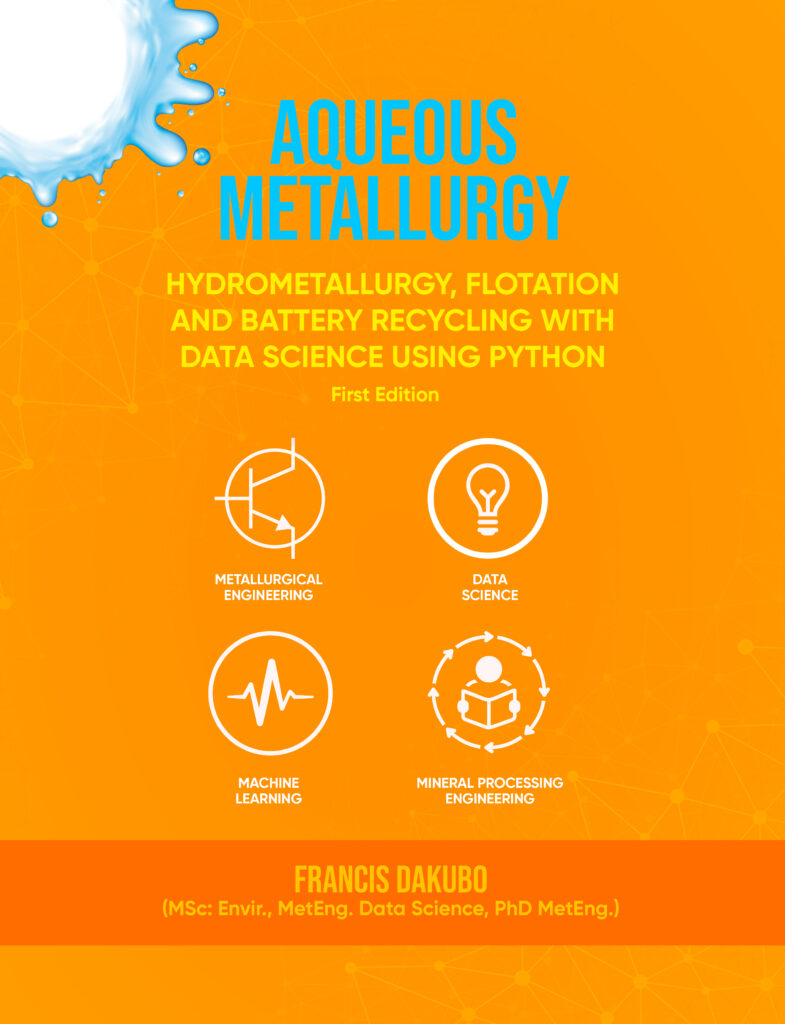
Aqueous metallurgy is a field that plays a crucial role in extracting minerals and producing metals for various industrial applications. It involves a range of processes, including hydrometallurgy, froth flotation, and battery recycling. In today’s rapidly evolving technological landscape, the integration of Python programming and data science techniques has emerged as a powerful tool in advancing aqueous metallurgy. In this blog post, we’ll explore the significance of Python programming in the context of the book “Aqueous Metallurgy: Hydrometallurgy, Flotation and Battery Recycling with Data Science Using Python” by Francis Dakubo.
Understanding Aqueous Metallurgy
Before diving into the role of Python programming, let’s briefly revisit the fundamentals of aqueous metallurgy. This field employs water as the primary medium for chemical reactions, making it a versatile and environmentally friendly approach to mineral extraction and metal production. Key processes within aqueous metallurgy include leaching, solvent extraction, carbon adsorption, electrowinning, and flotation.
Leaching is a pivotal method used to dissolve minerals within host rocks, effectively releasing them into a solution. This process can be achieved using various lixiviants, such as cyanide, sulfuric acid, or other specialized chemicals, depending on the mineral of interest. Once the minerals are dissolved, further steps involve purification, solid-liquid separation, and ultimately, metal production. These processes are essential for mineral resource prediction, metallurgical accounting, and financial budget projections.
The Role of Python Programming
Now, let’s explore why Python programming is a game-changer in the field of aqueous metallurgy, as highlighted in Francis Dakubo’s book:
Data Science Integration: Python is a versatile and open-source programming language known for its extensive libraries, including Numpy, SciPy, Pandas, and Matplotlib. These libraries are instrumental in data analysis, manipulation, and visualization. In the context of aqueous metallurgy, Python enables professionals to work with large datasets efficiently, extract valuable insights, and make informed decisions.
No Prior Programming Experience Required: One of the significant advantages of Python is its accessibility. The book assumes no prior programming experience in metallurgy, materials, mining, or any related fields. It provides a gentle introduction to Python programming, starting with fundamental concepts like data types, loops, and functions, making it accessible to both beginners and experts in the field.
Predictive Analytics: Python’s capabilities extend beyond data manipulation. Predictive analytics is a vital component of mineral and metal forecasting within aqueous metallurgy. Python allows professionals to create predictive models based on data from various branches of aqueous metallurgy, including leaching, solvent extraction, ion exchange, adsorption, crystallization, electrowinning, and flotation. These predictive models are invaluable for making financial projections and optimizing processes.
Versatility in Applications: Python’s versatility makes it suitable for a wide range of applications within aqueous metallurgy. Whether you’re analyzing the leaching of gold, copper, uranium, or other minerals, Python can handle the complexity of these processes and help you extract valuable information.
In conclusion, Python programming is transforming the field of aqueous metallurgy by providing professionals and students with a powerful toolset for data analysis, predictive modeling, and process optimization. Francis Dakubo’s book, “Aqueous Metallurgy: Hydrometallurgy, Flotation and Battery Recycling with Data Science Using Python,” serves as an excellent resource for individuals looking to bridge the gap between metallurgy and data science.
As the demand for sustainable and efficient mineral extraction processes continues to grow, the integration of Python programming and data science techniques will play a pivotal role in shaping the future of aqueous metallurgy. Whether you’re a student, practicing engineer, or scientist, embracing Python in this field can open up new possibilities and contribute to advancements in mineral resource management and metal production.