
Grinding is a crucial process in mineral processing. It involves reducing the size of ore particles to a level where mineral separation can be performed efficiently. This size reduction process, often called comminution, is performed in grinding mills that utilize different physical forces, including impact, attrition, and abrasion, to achieve particle size reduction.
There are two significant types of grinding mills:
- Tumbling mills: These mills use the kinetic energy of tumbling, cascading, or rolling grinding media to impact the ore particles in mechanically induced attrition. They include rod, ball, and semi-autogenous (SAG) mills.
- Stirred mills: These mills use rotational motion to create shear and impact forces on the ore particles. They include Vertimills, IsaMills, and high-intensity grinding mills.
The grinding mill type selection depends on the ore’s characteristics and the desired liberation size.
Safety Around Milling Equipment
Ensuring the safety of personnel and equipment during grinding operations is of paramount importance. Below are some of the ways to ensure safety:
- Equipment Maintenance: Regular maintenance of grinding mills and other equipment is essential. This includes regular inspection of liners, grinding media, drive systems, etc. Damaged or worn-out parts should be replaced promptly to avoid sudden breakages during operation.
- Proper Training: Workers should be adequately trained about the safe operation of the equipment, potential hazards, and the appropriate safety measures taken in an emergency. Regular safety refresher training helps maintain high safety standards.
- Personal Protective Equipment (PPE): Operators should always wear appropriate PPE, such as safety goggles, hard hats, ear protection, and safety shoes. Dust masks may also be necessary, as conveying and grinding processes generate substantial dust.
- Machine Guarding: Grinding equipment should have appropriate machine guarding to protect operators from flying debris and to prevent access to moving parts.
- Dust Control: Grinding can generate a significant amount of dust, which can be a health hazard and cause equipment malfunctions if not adequately controlled. Dust collection systems and regular cleaning can help to mitigate this risk. A dust mask should be always worn when working around dusty environment.
- Noise Control: Grinding mills can be very loud, potentially causing hearing damage over the long term. Noise control measures should be implemented, such as noise barriers or soundproofing of operator cabins.
- Emergency Procedures: In an emergency, procedures should be in place to safely shut down equipment and evacuate personnel. Emergency exits should be clearly always marked and unobstructed.
- Safety Signs: Clear signage indicating potential hazards, required PPE, and safety procedures should be visible in all areas.
- Lockout/Tagout Procedures: When equipment is being serviced or maintained, it should be locked out and tagged out to prevent accidental start-up, which can cause serious injuries.
Adhering to these guidelines and implementing a safety culture can significantly reduce risks to personnel and equipment during grinding operations.
Grinding Models
The behavior of the grinding process can be modeled using various mathematical models, which are based on specific energy, population balance, and perfect mixing.
- Specific Energy Model (Bond’s Law): The energy required for size reduction is proportional to the change in surface area. This is often represented by Bond’s Law,
, where E is the specific energy, Wi is the work index of the material, P80 is the 80% passing size of the product, and F80 is the 80% passing size of the feed.
Bond Work Index
Bond Work Index, denoted by Wi, is an empirical measure of the energy required to grind a given quantity of material to a desired fineness. This energy is usually measured in units of kilowatt-hours per ton. The Bond index is widely used in mineral processing for designing grinding circuits and sizing equipment, and it serves as a critical parameter for process optimization. The Bond index is determined in a lab-scale mill called the Bond index mill and then used to design full-scale mills.
The equation you provided is a representation of the Bond Work Index.
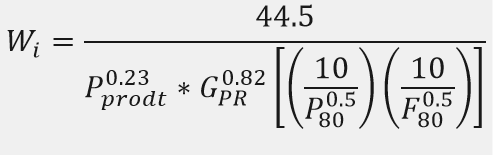
where:
- Wi is the Work Index
- Pprodt is the product size in micrometers that 80% of the product passes
- GPR is the Grindability in grams per revolution
- P80 is the screen test size in micrometers
- F80 is the size in µm at which 80 per cent of new feed passes
Let’s consider an example where after the grinding test we obtained the following data,
Pprodt= 150 µm
GPR= 1.115 µm
P80= 115 µm
F80= 1980 µm
We can compute the energy required to grind the material using the code,
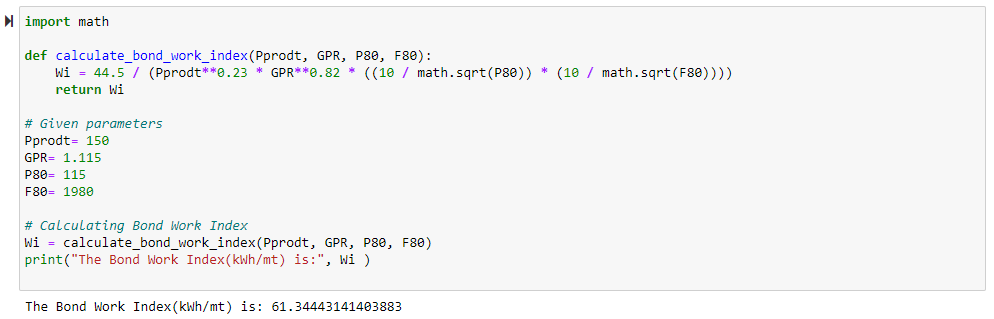
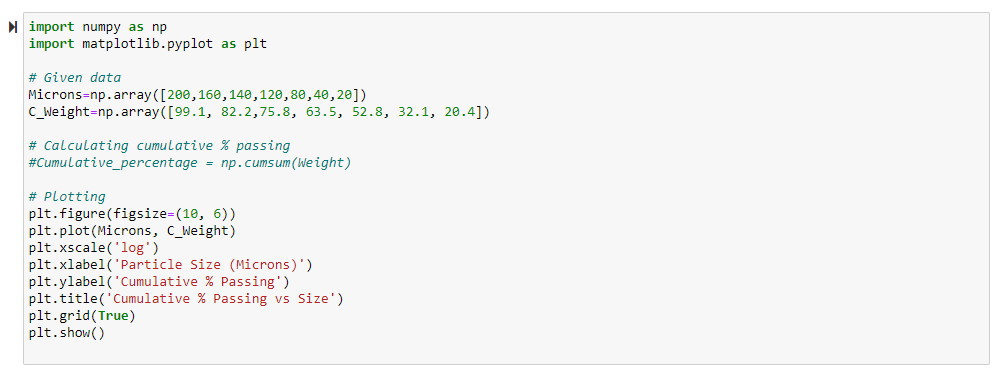
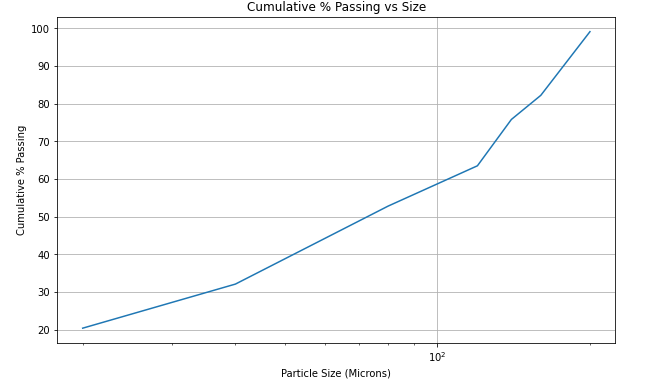
If the distribution of particles in the product after grinding is given by
Microns=np.array([200,160,140,120,80,40,20])
C_Weight=np.array([99.1, 82.2,75.8, 63.5, 52.8, 32.1, 20.4])
Population Balance Model: This model considers the breakage rate and selection function, which describes how likely a particle will be selected for breakage and how it breaks. This model is more comprehensive and can predict product size distribution.
The Population Balance Model (PBM) is a mathematical model that represents the rate of change of particle size distribution (PSD) in a comminution (grinding) process. In its most basic form, the PBM can be represented as a first-order, linear, homogeneous, partial differential equation (PDE) i.e.,

Where, n(x, t) is the number density function which describes the particle size distribution at time t, S(x) is the selection function which is a probability that a particle of size x will be broken, and B(x,y) is the breakage function which represents the probability that a particle of size y will break to form a particle of size x.
Breakage: It is the breaking of particles into smaller fragments. The breakage rate is a function of particle size, and in the PBM, it is represented by a breakage function B(x,y), which describes the probability that a particle of size y will break to form a particle of size x.
Selection: This is the chance that a particle is selected to be broken. This is represented by a selection function S(x), which is typically a function of the particle size and other factors like mill conditions and material properties.
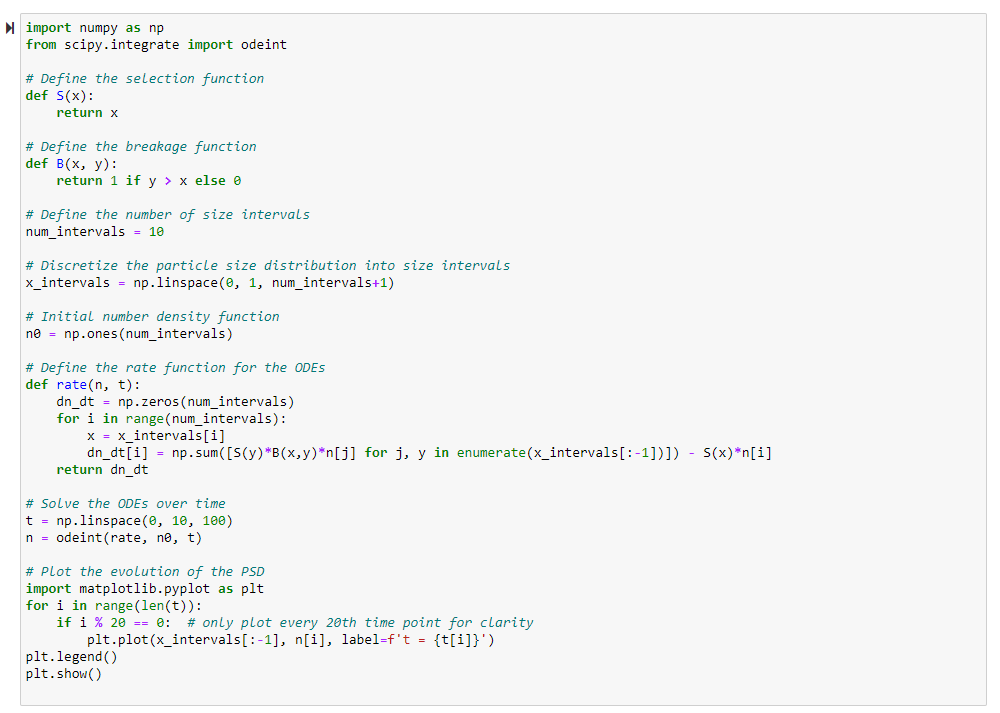
The continuous form of the PBM model shown above can be discretized into a set of ordinary differential equations (ODEs) representing size intervals, making it easier to solve numerically.
The code below is a simplified model of the PBM model.
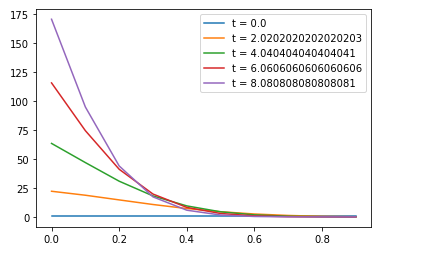
The PBM model can be used to optimize the grinding process in several ways:
- Design and Scale-Up: PBM can predict how a change in mill design or size will affect performance, aiding in the design and scale-up of grinding circuits.
- Circuit Optimization: By simulating different operating conditions and configurations (e.g., different mill speeds, feed rates, or liner designs), PBM can help to identify the conditions that maximize grinding efficiency.
- Process Control: PBM can be used with control algorithms to create dynamic simulations that assist in designing and implementing control strategies for grinding circuits. In all these cases of using PBM, our goal is to adjust the system’s parameters to achieve the desired PSD while minimizing energy consumption.
- Perfect Mixing Model: This model treats the mill as an ideal mixer and assumes the product particles are withdrawn from the mill perfectly mixed.
Efficiency Grinding Process
The efficiency of the grinding process can be improved by focusing on several factors, namely the grinding media, mill design, operating conditions, and the use of grinding aids. Let’s delve into each:
- Grinding Media: The size, shape, density, and hardness of grinding media can significantly impact grinding efficiency. Smaller media are generally more efficient as they provide more surface area for particle-to-particle contact but may also increase the likelihood of over-grinding. A balance must be struck depending on the specific needs of the operation. Harder media can be more effective at breaking hard ores.
- Mill Design: The design of the mill also plays a crucial role. For example, in a ball mill, a lifter’s design can affect the media’s fall, thus impacting the grinding efficiency. Similarly, the design of the discharge arrangement can influence how efficiently the milled product is removed, reducing the chance of over-grinding.
- Operating Conditions: This includes mill speed, feed rate, pulp density, and particle size distribution of the feed. Mill speed should be tuned for optimal impact. A high feed rate can lead to a coarser grind, while a lower rate allows for a finer grind. Pulp density can impact the grinding efficiency as well. A higher density might lead to higher grinding efficiency but also increase wear and energy consumption.
- Grinding Aids: These are substances that, when mixed into the mill contents, cause an increase in the size reduction rate. They function by reducing the surface energy forces, which cause agglomeration of the newly fractured pieces of the material.
Balancing the trade-off between achieving a finer grind for better mineral liberation and the increased energy cost associated with finer grinding is a complex task that requires understanding both the ore characteristics and the grinding operation’s parameters.
- Understanding the Ore: The first step is understanding the ore’s mineralogy, particularly the grain size of the valuable mineral(s) within the ore. This can be determined through a process called mineral liberation analysis. A finer grind may be necessary for adequate liberation if the minerals of interest are fine-grained and disseminated throughout the ore. If they are coarse-grained and easily detachable, a coarser grind may suffice.
- Grinding Efficiency and Energy Consumption: The grinding efficiency is often described by the specific energy as described above, which is the energy required to grind a ton of ore to a certain size. According to Bond’s Law, the specific energy (E) is given by.

where E is the specific energy, Wi is the work index of the material (a measure of its resistance to grinding), P80 is the 80% passing size of the product, and F80 is the 80% passing size of the feed.
This equation shows that a finer product (lower P80) requires more energy per ton of ore. Thus, grinding to a finer size increases energy costs.
- Balancing the Trade-off: The trade-off between finer grinding (better liberation) and energy cost is about finding the optimum P80 that maximizes the net economic benefit. This involves calculating the additional revenue from improved mineral recovery against the extra energy costs of finer grinding. The optimum can be found by setting the derivative of the net benefit equation concerning P80 equal to zero and solving for P80. This equation would consider the ore price, recovery as a function of grind size, energy cost, and energy consumption as a function of grind size.
- Implementing the Optimum Grind Size: Once the optimum grind size is determined, the grinding circuit’s operating parameters (e.g., mill speed, feed rate) should be adjusted to achieve this size as efficiently as possible. Continuous monitoring and periodic ore characterization are also necessary to ensure that the optimum conditions remain valid as the ore characteristics vary over time.
Understanding these dynamics and utilizing tools such as process modeling, simulation, and control can help effectively manage this trade-off and ensure the grinding operation is optimized for energy efficiency and mineral liberation.
Process Modeling
Process Modeling involves creating mathematical models that describe the behavior of the grinding process, considering factors such as mill speed, feed rate, particle size distribution, and the ore’s characteristics. These models can be based on mechanistic principles (such as the Population Balance Model) or empirical correlations (like Bond’s Law). Process modeling allows for predicting the grinding circuit’s performance under different conditions.
For example, Bond’s equation:
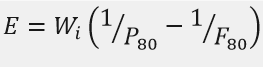
can be used as a basic model to estimate the specific energy consumption, where E, Wi, P80 , and F80 have their usual meaning.
Simulation
Once you have a model, you can use it to run simulations with different input parameters to predict how changes will affect outcomes. This is a powerful tool for testing different scenarios and optimizing the operation without experimenting with the actual system. For instance, you might run simulations to determine the optimal feed rate or mill speed that gives you the desired P80 while minimizing energy consumption.
Control Strategies
The final step is to implement control strategies that ensure the grinding process stays close to the optimal conditions the models and simulations determine. This often involves feedback control systems that continuously monitor vital parameters (like the particle size distribution of the output) and adjust the system’s inputs (like mill speed or feed rate) to maintain these parameters at their desired values. For example, an advanced control strategy like Model Predictive Control (MPC) can handle multivariable systems and constraints. MPC uses a dynamic model of the system, optimizes the control actions over a future horizon, and only implements the first control action. This process is repeated at each control step, providing a robust and efficient way to maintain the grinding process at its optimal operating point. Leveraging process modeling, simulation, and control, it is possible to effectively manage the trade-off between achieving a finer grind for better mineral liberation and the increased energy cost associated with finer grinding, leading to improved efficiency and profitability in the grinding process.