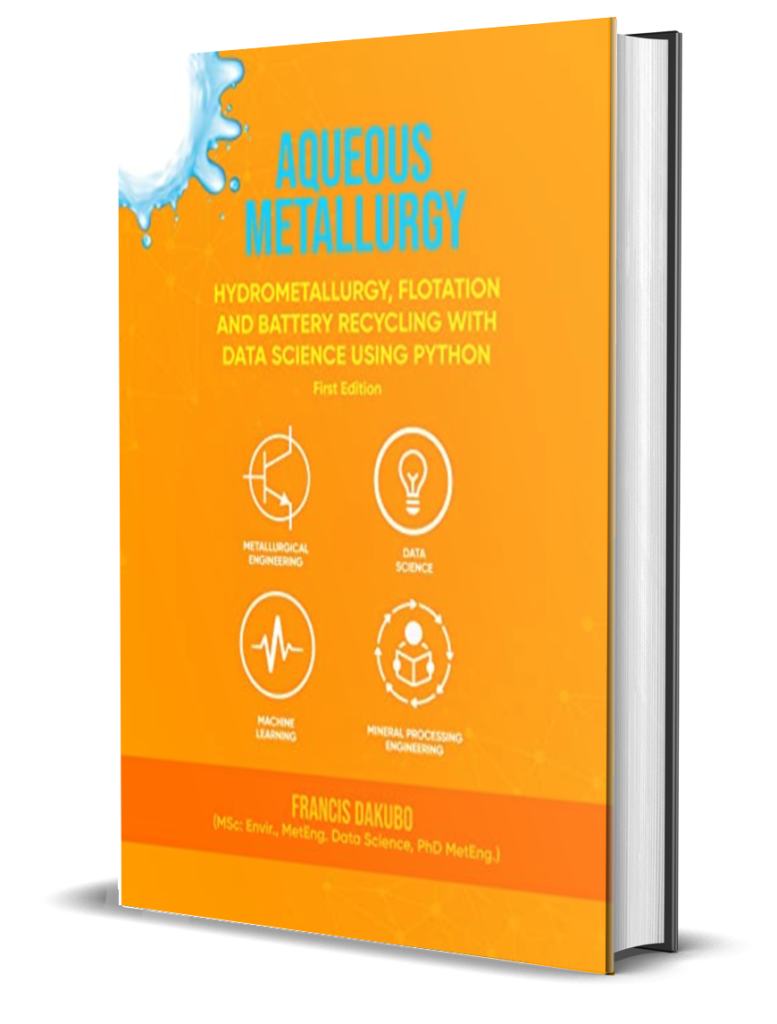
In the realm of extractive metallurgy, a revolutionary approach is reshaping the landscape of mineral extraction and metal production. Aqueous metallurgy, characterized by its low-energy aqueous methods, has emerged as a sustainable and efficient solution for harnessing the power of minerals and metals. With the release of “Aqueous Metallurgy: Hydrometallurgy, Flotation, and Battery Recycling with Data Science Using Python” by Francis Dakubo, a new era of possibilities has dawned for metallurgical professionals, engineering students, and scientists alike.
Aqueous Metallurgy: Paving the Path to Sustainable Extraction
Aqueous metallurgy, often referred to as hydrometallurgy, stands as a beacon of innovation in the world of metallurgy. Unlike traditional energy-intensive methods, it relies on water-based processes to extract minerals and produce metals. This not only minimizes the environmental impact but also streamlines production, making it an increasingly attractive option in a world striving for sustainable practices.
Revolutionizing the Approach with Python Programming
The release of “Aqueous Metallurgy: Hydrometallurgy, Flotation, and Battery Recycling with Data Science Using Python” is a watershed moment in this field. Authored by Francis Dakubo, this groundbreaking book bridges the gap between chemistry, engineering, and data science. By incorporating Python programming, the book redefines how aqueous metallurgy is understood and applied.
Key Topics Explored in the Book
Dakubo’s book delves into a comprehensive array of topics that are fundamental to aqueous metallurgy:
Copper and Gold Leaching: Learn how aqueous methods are employed to extract valuable metals like copper and gold, transforming ores into valuable resources.
Solvent Extraction: Understand the intricate process of separating metals from solutions using selective solvents, a technique pivotal in the metallurgical landscape.
Carbon Adsorption: Explore how carbon-based materials can selectively adsorb metals from solutions, contributing to efficient separation processes.
Mixing Theory: Gain insights into the science behind mixing processes, a critical component of successful metallurgical operations.
Electrowinning: Dive into the world of electrowinning, a technique that utilizes electrical currents to extract metals from solutions, reducing energy consumption.
Battery Recycling: Discover how aqueous metallurgy plays a role in the recycling of batteries, a crucial endeavor for sustainable resource management.
Surface Chemistry and Flotation: Grasp the significance of surface chemistry in flotation processes, which facilitate the separation of minerals from ores.
A Multifaceted Resource for Diverse Audiences
This book is not only a valuable resource for metallurgical professionals seeking innovative ways to optimize their processes but also an essential companion for engineering students aspiring to excel in their field. Scientists dedicated to pushing the boundaries of metallurgy can find inspiration in the integration of data science, opening doors to new avenues of exploration.
Metallurgical Accounting and Forecasting: A Game-Changer
One of the most notable features of “Aqueous Metallurgy” is its emphasis on metallurgical accounting and forecasting. The book equips experts with predictive analytics tools that enable accurate forecasting of mineral resource availability and operational efficiency. Python’s powerful open-source libraries—such as Numpy, SciPy, Pandas, and Matplotlib—are harnessed to analyze and visualize data, empowering professionals to make informed decisions.
In conclusion, “Aqueous Metallurgy: Hydrometallurgy, Flotation, and Battery Recycling with Data Science Using Python” is a trailblazing publication that ushers in a new era of metallurgical innovation. By combining chemistry, engineering, and programming, it showcases the immense potential of multidisciplinary collaboration. As the world seeks sustainable solutions, this book provides a roadmap to harnessing the power of aqueous methods for a brighter, greener future in metallurgy and beyond.